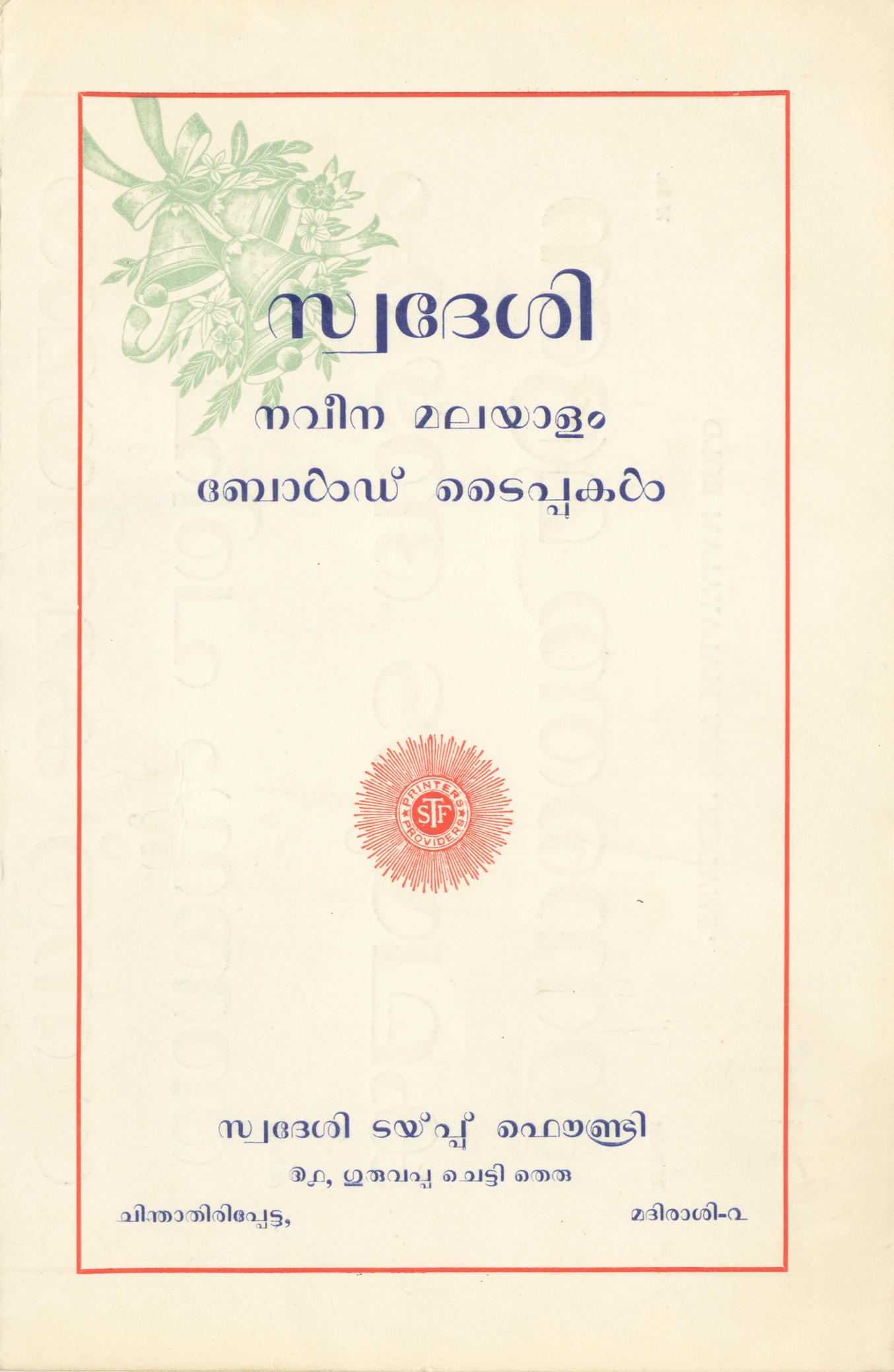
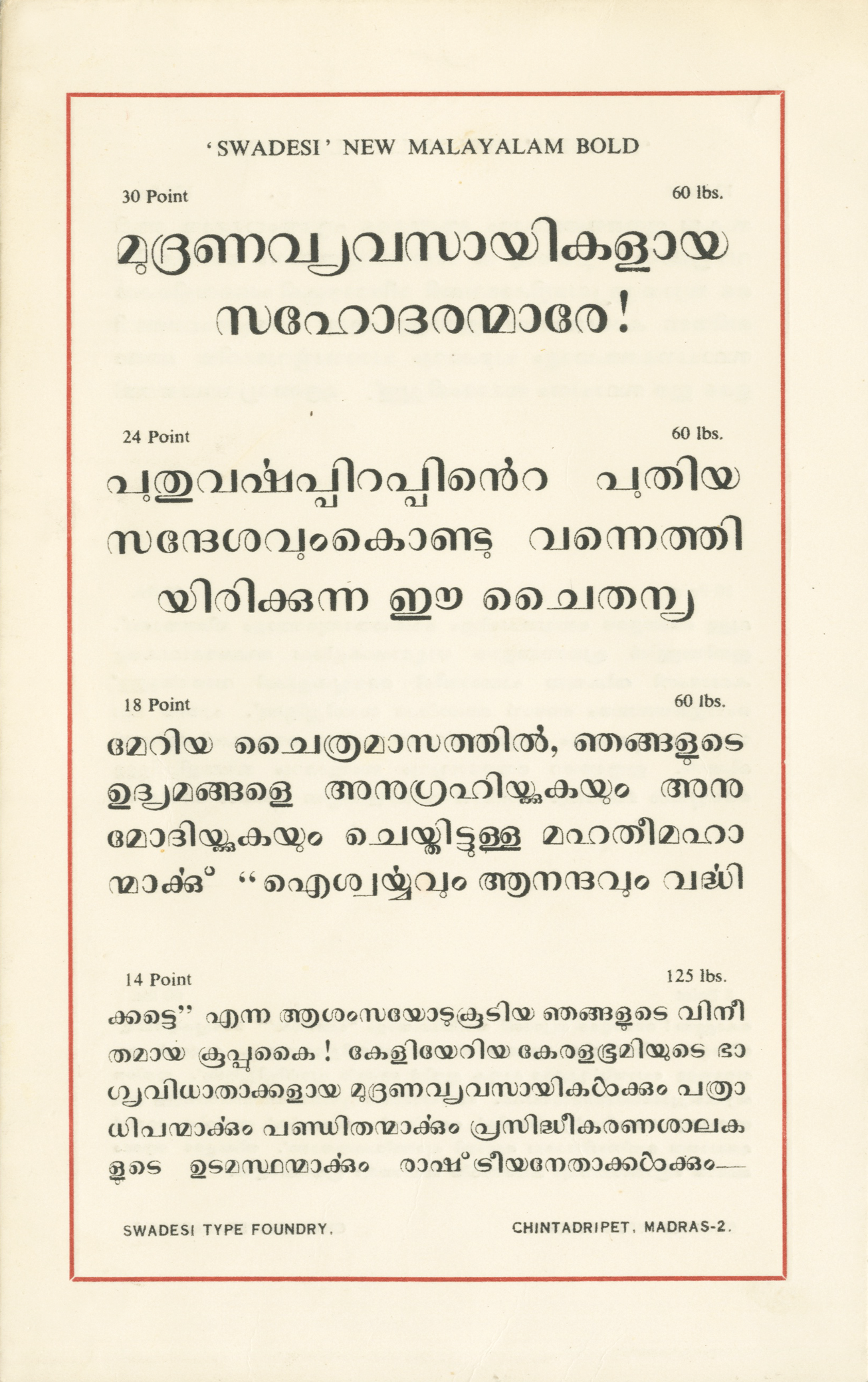
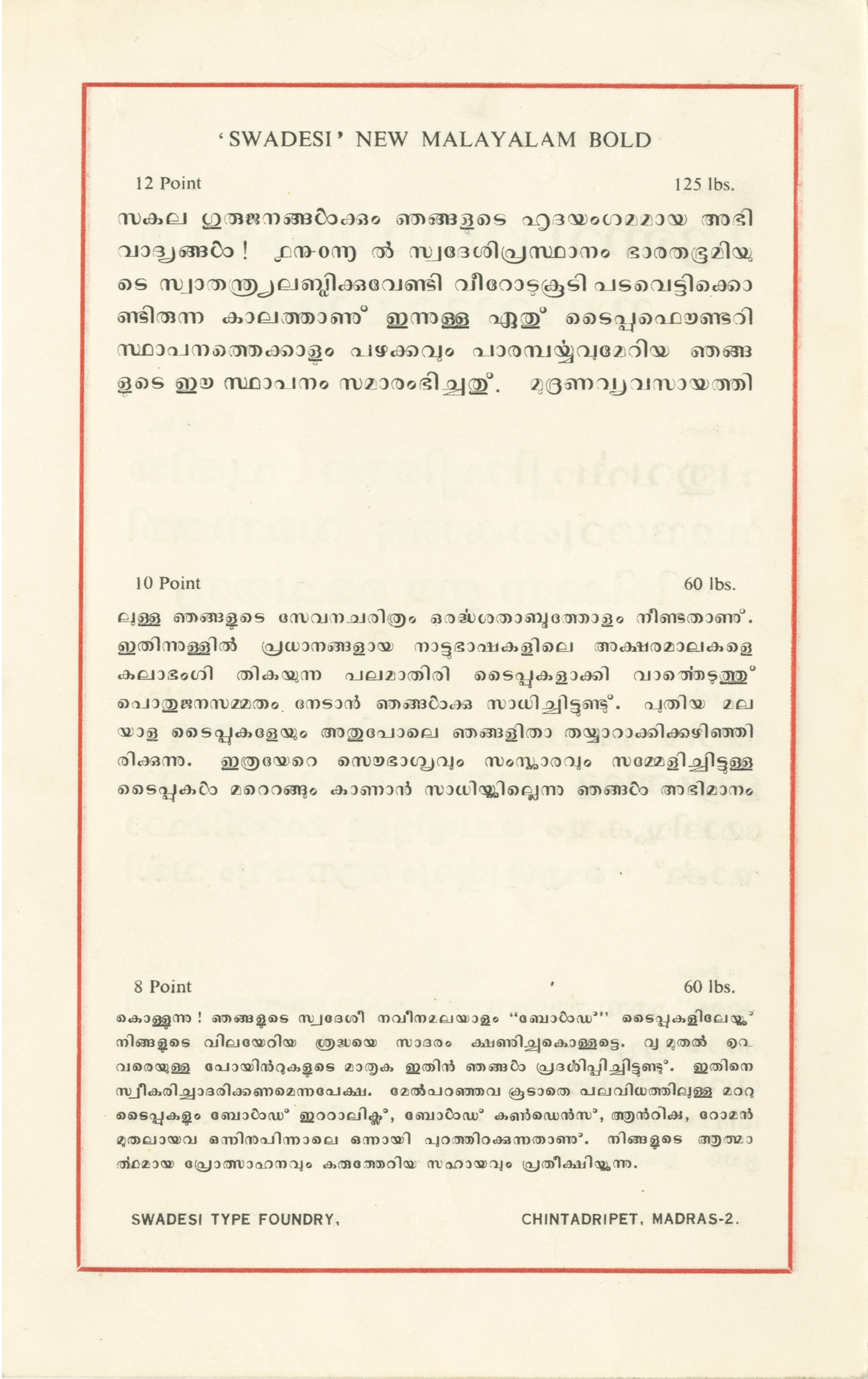
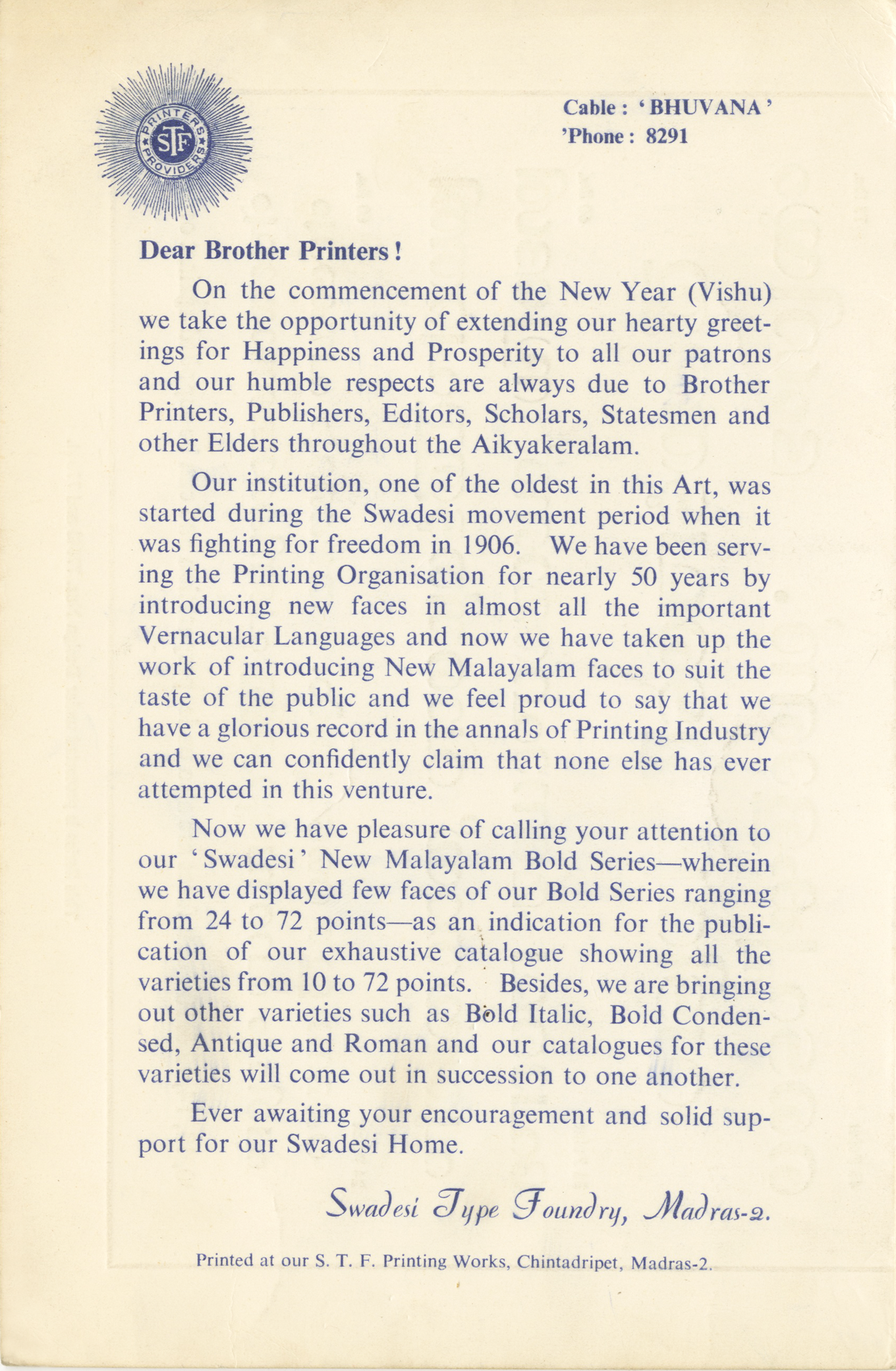
സ്വദേശി നവീന മലയാളം ബോൾഡ് ടൈപ്പുകൾ or Swadesi Naveen Malayalam Bold Typekal from the Swadesi Type Foundry showcases a Malayalam typeface named Swadesi New Malayalam Bold in various sizes, ranging from display to text. Malayalam is a language primarily spoken in Kerala, and its script has experienced some radical transformations.
The Malayalam script in this specimen is now known as the Traditional Malayalam script. One of the notable features of Malayalam's orthography is each consonant, which – when combined with a vowel sound such as U (ു), Uu (ൂ), or vocalic R (ൃ) – forms a unique shape. It also has several horizontal and vertical conjuncts, and the same logic of vowel sound combination applies to them as well, leading to an extensive glyph set ranging from 800 to thousands of glyphs.
This complexity has posed significant challenges in designing and typesetting metal type. Over the years, several attempts were made to reform the Malayalam script, leading to its gradual evolution.
The typewriter played a crucial role in accelerating a process that had been ongoing for decades, leading to a major script reform in 1971 by the Government of Kerala. This reduced the original glyph set from thousands of characters to barely 90, giving birth to a new orthography known as Simplified Malayalam script.
Major changes in this simplified orthography include detached vowel signs for U (ു), Uu (ൂ), and vocalic R (ൃ), along with a reduction in conjuncts by using chandrakala (്). While the simplified orthography was widely adopted in printing, traditional orthography has been retained in handwriting.
Today, Malayalam typefaces are available in both traditional and simplified scripts, with some incorporating elements from both versions. This duality extends to handwriting and lettering as well and remains a hot topic of discussion among readers, researchers and designers. New readers learn the traditional script from their parents or through being exposed to it on signboards or other public lettering.
In 2022, the Government of Kerala issued another script reform, which is a mixture of both orthographies. It retains detached vowel U (ു) and vowel Uu (ൂ) signs and adds more conjuncts with combined forms for vocalic R sign (ൃ) and Ra (്ര) conjuncts – though its implementation is yet uncertain. This 2022 version has proved challenging for people who are used to writing in the 1971 reformed script, and both orthographies have different characters sets and OT coding – so require two different fonts. Reactions to this reform were mostly negative. Publishers haven’t changed their fonts and type designers have continued to make traditional orthography typefaces for people to use.
This specimen showcases the Malayalam typeface in traditional orthography, with regular width, bold weight and very high contrast. It is characterised by curved, crescent-shaped terminals, a few ball terminals – evident in the Chillu (consonants without any inherent vowel sounds are known as ചില്ലു (Chillu) letters) forms (ൻ, ൽ) – and initial loops emerging from the bottom.
The very high contrast makes it ideal for display purposes, giving it a clean and modern look, but the below-base vowel forms (small circles below the consonants) look almost invisible. The text sizes, while featuring lower contrast and looser spacing compared to the display sizes, still retain a relatively higher contrast than standard text faces.
The below-base vowel forms and vertical conjuncts are detached in larger sizes but attached in smaller sizes. Letter structures remain unchanged from display to text, but some inconsistencies are present. This specimen also showcases an 8pt size, but the high contrast and loose spacing make it somewhat uncomfortable to read. There are glyph drawing inconsistencies, which are bound to happen due to manual work. For instance, the balance of the above and below space distribution of letter Tta (ട) is inconsistent. In 48pt, letter Ga (ഗ) seems to be like a mistake where it looks like letter Sha (ശ) without the loop.
Being a typeface from the 1950s, it includes Malayalam numerals that are no longer in contemporary use. Today, this script uses western numerals. Additionally, the typeface features several letterforms in their older structures. For example, the letter Chillu Lla (ൾ) resembles an infinity sign, a form that has since evolved to look more like the letter Sha (ശ). Similarly, the letters Ga (ഗ) and Sha (ശ) have thick sides and thin middles, whereas their modern counterparts have the opposite contrast.
Even the modulation of anuswar (ം), with an angular stress, and loop of vowel Aa (ആ), that goes all the way up, is also a reminder of old style structures. Another distinct feature common in fonts of this era is the vertical conjunct form of Ka (്ക), where the top portion of Ka (ക) is removed – a stylistic choice evident in this specimen.
While this typeface mostly aligns with the proportions of contemporary Malayalam typefaces, certain characters retain old-style proportions, such as the wide forms of La (ല), Ya sign (്യ) and Va sign (്വ).
Though this typeface has decent structures and proportions, it is important to note that due to technological limitations, it has several inconsistencies in design, proportions and spacing. If a designer were to replicate this as a contemporary typeface today, several decisions would need to be reconsidered, including structure, proportion, spacing, contrast and which orthography to choose.